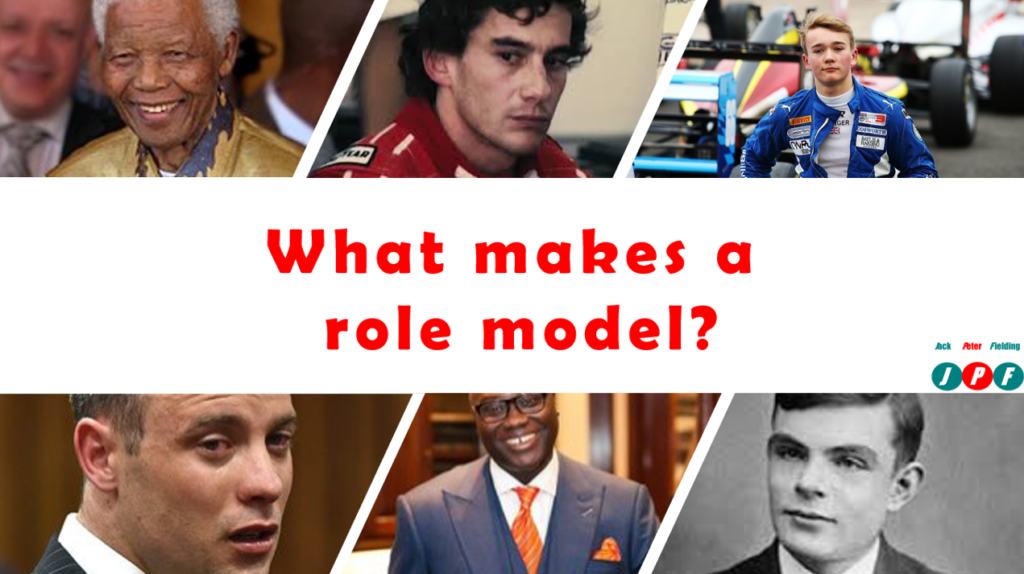
What makes a role model?
We all have different role models, or people we look up to these can be both good (mostly) and bad. Mostly we describe role models as ‘A person who serves as an example of the values, attitudes, and behaviours associated with a role.’ Normally we think of role models as people like Nelson Mandela, Ayrton Senna, or big global stars.
However, I believe that role models aren’t necessarily these big global names, famous or well-known, these can be people we all know from our own lives. Role models are based not only on what they do but how they do it, what they change for the better and the fight.
Nelson Mandela, one of the most important figures in politics, leading black South Africans against the white minority rule, by peaceful motives. But his imprisonment by the state for his fight against apartheid. He ought for the racial classification, that led to his imprisonment.
Mandela did it without violence but was imprisoned on Robin Island for twenty-seven years. But following his release, he led his party to power for the first time. He wasn’t greedy he wasn’t seeking revenge for the white rule but created a racially equal South Africa. You saw after his death what he meant to the world and more importantly South Africa.
I have been described as a role model and as someone with morals, I think that’s because of my challenges. I don’t believe I am a role model, but I accept I have overcome a lot of challenges.
Role models have their own role models.
We can look to different role models depending on what we are doing, say sport we may look to Ayrton Senna, in business Lord Sugar, disability Billy Monger etc. I think we have many different role models, and we draw on the most relevant one depending on the situation that we are in.
Senna, we know what he did in F1, but dig deeper into his story I say look at what he did for Brazil. He had concerns about the poverty in Brazil donating millions to help the poorest. Some say he was the president that Brazil never had.
His legacy continues, thanks to his family creating opportunities for children and teenagers from low-income backgrounds. Giving them the skills and opportunities, they need to develop their full potential as persons, citizens, and future professionals.
Billy Monger has become one of the most inspiring young people in recent years. I remember watching the accident at Donnington in 2017, and how he has come back into the sport since is remarkable.
Monger lost both legs but returned to racing in November the same year. He tested a car just four months after his accident, before taking on the FIA successfully to remove the governing body’s restrictions disabled drivers from racing single seaters on the grounds of safety.
Really hope he gets into F1 on merit.
Role models are there to inspire us, we often look back to our history for things to inspire us. But we will see new inspirations emerge every day, they don’t set out to be inspirations. It can be both what they stand for and what they fight against.
We are all and can be role models for people, but we may not realise that we are.
One moment can see you become an inspiration, and that can be lost. Alan Turing the father of computing and the man who arguably defeated the Nazi’s. Turing was convicted for being gay, but he is one of the greatest inventors of history he founded the basis for every computer.
One of our greatest role models, but failed to get the real recognition he needs. Arguably his suicide shows us what being victimised can lead to. However, his name gives itself to the royal pardon men who were cautioned or convicted under historical legislation that outlawed homosexuality.
Oscar Pistorius, I think would be a role model, he took on the Olympics and became the only blade runner to compete in the abled body games. But his legacy could have been great, but no one knows what really happened on 14 February 2014 when he killed his girlfriend.
But beyond the achievements of international or national importance, in our communities, there are people around us. I have met some amazing people, one of them, a woman in her nineties have told me about being an air raid warden, travelled to Kong Hong with her husband to teach Chinese students where she had a baby.
So my message would be, look for the heroes in your community.
As I journalist/reporter I look up to Komla Dumor, not a well-known figure but he should be remembered for what he did as a reporter. He wanted to tell a story of the ‘new Africa’, of business, arts and the ordinary people rather than war and famine.
Dumour’s death came suddenly as he was emerging as a great journalist and presenter. A month before his death, his most memorable interview was with Makaziwe Mandela, days after her father’s death. In tribute, the Mandela’s contacted the BBC asking to speak to about Komla.
Our lives are shaped by the people around us, we can take inspiration from anyone. Normally, friends become role models in their darkest hour. I hear amazing stories about people you wouldn’t hear about in the media. I believe that news is good, but the most powerful stories are from ordinary people.
However, following or copying your icons is wrong. You should live by their example but you mustn’t become them. No icon is perfect, but we need to understand their failings and learn from them.
For me being called a role model often begs the thought why? While I accept, I can be an inspiration people don’t understand fully what I need to do and what I have done to so I can live how I am currently living. I do find it difficult to understand why I am a role model, but it is flattering.
Another question I ask is who inspires the role models. We role models don’t think we are role models. I know many disabled people who you could describe as role models, but we have overcome challenges.
Who is your role model, a role I think means something you aim to follow, and, in every way, the ultimate challenge is their ideals. I believe we all want to improve the world for the better.